At a Glance

Beyond the Chatbot

Designing AI therapy around outcomes, not a single interface.

I started a series of research and prototyping projects to challenge the assumption that AI therapy needed to happen entirely through text chat. Using product data and working prototypes, I showed how voice, video, audio and structured activities could make different therapeutic moments clearer and more engaging. The evidence helped Product, Engineering and senior stakeholders commit to choosing the format around the therapeutic need—not defaulting to chat.

Role

Design Director

Focus

AI interaction design, rapid prototyping, research

Worked with

Clinical, AI, Product, Engineering

When

2022–2026

At a Glance

Beyond the Chatbot

Designing AI therapy around outcomes, not a single interface.

I started a series of research and prototyping projects to challenge the assumption that AI therapy needed to happen entirely through text chat. Using product data and working prototypes, I showed how voice, video, audio and structured activities could make different therapeutic moments clearer and more engaging. The evidence helped Product, Engineering and senior stakeholders commit to choosing the format around the therapeutic need—not defaulting to chat.

Role

Design Director

Focus

AI interaction design, rapid prototyping, research

Worked with

Clinical, AI, Product, Engineering

When

2022–2026

At a Glance

Beyond the Chatbot

Designing AI therapy around outcomes, not a single interface.

I started a series of research and prototyping projects to challenge the assumption that AI therapy needed to happen entirely through text chat. Using product data and working prototypes, I showed how voice, video, audio and structured activities could make different therapeutic moments clearer and more engaging. The evidence helped Product, Engineering and senior stakeholders commit to choosing the format around the therapeutic need—not defaulting to chat.

Role

Design Director

Focus

AI interaction design, rapid prototyping, research

Worked with

Clinical, AI, Product, Engineering

When

2022–2026

At a Glance

Beyond the Chatbot

Designing AI therapy around outcomes, not a single interface.

I started a series of research and prototyping projects to challenge the assumption that AI therapy needed to happen entirely through text chat. Using product data and working prototypes, I showed how voice, video, audio and structured activities could make different therapeutic moments clearer and more engaging. The evidence helped Product, Engineering and senior stakeholders commit to a broader interaction model.

Role

Design Director

Focus

AI interaction design, rapid prototyping, research

Worked with

Clinical, AI, Product, Engineering

When

2022–2026

At a Glance

Beyond the Chatbot

Designing AI therapy around outcomes, not a single interface.

I started a series of research and prototyping projects to challenge the assumption that AI therapy needed to happen entirely through text chat. Using product data and working prototypes, I showed how voice, video, audio and structured activities could make different therapeutic moments clearer and more engaging. The evidence helped Product, Engineering and senior stakeholders commit to choosing the format around the therapeutic need—not defaulting to chat.

Role

Design Director

Focus

AI interaction design, rapid prototyping, research

Worked with

Clinical, AI, Product, Engineering

When

2022–2026

The Challenge

Challenge the assumption that a better chatbot could carry the whole therapy experience, when live product data and research were showing its limits.

For People

Make it easier to interact, listen and reflect—even when anxiety, low mood or cognitive load made taking part harder.

For the Product

Use the format that best supported each therapeutic goal, while keeping the wider experience coherent.

For ieso

Keep the therapy clinically sound while making the digital experience easier to understand and take part in.

My Contribution

Started with what people needed to understand, do or feel, then mapped those needs to different formats.

Created reusable session patterns and working AI prototypes in code.

Initiated and led iterative research, using evidence to build support for a broader interaction model.

The Impact

A Broader Interaction Model

User testing helped convince Product, Engineering and senior stakeholders to move beyond a single, all-purpose chatbot and choose formats around the therapeutic need.

Prototypes People Could Try

The prototypes were used in customer demonstrations and gave Clinical, Product and Engineering something realistic to test, discuss and build from.

Risks Surfaced Early

Exposed expectation and intent mismatches before implementation.

The Challenge

Challenge the assumption that a better chatbot could carry the whole therapy experience, when live product data and research were showing its limits.

For People

Make it easier to interact, listen and reflect—even when anxiety, low mood or cognitive load made taking part harder.

For the Product

Use the format that best supported each therapeutic goal, while keeping the wider experience coherent.

For ieso

Keep the therapy clinically sound while making the digital experience easier to understand and take part in.

My Contribution

Started with what people needed to understand, do or feel, then mapped those needs to different formats.

Created reusable session patterns and working AI prototypes in code.

Initiated and led iterative research, using evidence to build support for a broader interaction model.

The Impact

A Broader Interaction Model

User testing helped convince Product, Engineering and senior stakeholders to move beyond a single, all-purpose chatbot and choose formats around the therapeutic need.

Prototypes People Could Try

The prototypes were used in customer demonstrations and gave Clinical, Product and Engineering something realistic to test, discuss and build from.

Risks Surfaced Early

Exposed expectation and intent mismatches before implementation.

The Challenge

Challenge the assumption that a better chatbot could carry the whole therapy experience, when live product data and research were showing its limits.

For People

Make it easier to interact, listen and reflect—even when anxiety, low mood or cognitive load made taking part harder.

For the Product

Use the format that best supported each therapeutic goal, while keeping the wider experience coherent.

For ieso

Keep the therapy clinically sound while making the digital experience easier to understand and take part in.

My Contribution

Started with what people needed to understand, do or feel, then mapped those needs to different formats.

Created reusable session patterns and working AI prototypes in code.

Initiated and led iterative research, using evidence to build support for a broader interaction model.

The Impact

A Broader Interaction Model

User testing helped convince Product, Engineering and senior stakeholders to move beyond a single, all-purpose chatbot and choose formats around the therapeutic need.

Prototypes People Could Try

The prototypes were used in customer demonstrations and gave Clinical, Product and Engineering something realistic to test, discuss and build from.

Risks Surfaced Early

Exposed expectation and intent mismatches before implementation.

The Challenge

Challenge the assumption that a better chatbot could carry the whole therapy experience, when live product data and research were showing its limits.

For People

Make it easier to interact, listen and reflect—even when anxiety, low mood or cognitive load made taking part harder.

For the Product

Use the format that best supported each therapeutic goal, while keeping the wider experience coherent.

For ieso

Keep the therapy clinically sound while making the digital experience easier to understand and take part in.

My Contribution

Started with what people needed to understand, do or feel, then mapped those needs to different formats.

Created reusable session patterns and working AI prototypes in code.

Initiated and led iterative research, using evidence to build support for a broader interaction model.

The Impact

A Broader Interaction Model

User testing helped convince Product, Engineering and senior stakeholders to move beyond a single, all-purpose chatbot and choose formats around the therapeutic need.

Prototypes People Could Try

The prototypes were used in customer demonstrations and gave Clinical, Product and Engineering something realistic to test, discuss and build from.

Risks Surfaced Early

Exposed expectation and intent mismatches before implementation.

The Challenge

Challenge the assumption that a better chatbot could carry the whole therapy experience, when live product data and research were showing its limits.

For People

Make it easier to interact, listen and reflect—even when anxiety, low mood or cognitive load made taking part harder.

For the Product

Use the format that best supported each therapeutic goal, while keeping the wider experience coherent.

For ieso

Keep the therapy clinically sound while making the digital experience easier to understand and take part in.

My Contribution

Started with what people needed to understand, do or feel, then mapped those needs to different formats.

Created reusable session patterns and working AI prototypes in code.

Initiated and led iterative research, using evidence to build support for a broader interaction model.

The Impact

A Broader Interaction Model

User testing helped convince Product, Engineering and senior stakeholders to move beyond a single, all-purpose chatbot and choose formats around the therapeutic need.

Prototypes People Could Try

The prototypes were used in customer demonstrations and gave Clinical, Product and Engineering something realistic to test, discuss and build from.

Risks Surfaced Early

Exposed expectation and intent mismatches before implementation.

Designing Therapy Beyond the Chat Window

Research, prototypes and reusable patterns helped us choose the right format for each therapeutic moment, rather than forcing every part of AI-led care through text chat.

1

Testing the Chatbot Assumption

Compared the same digital therapy sessions in text chat and more immersive formats to see which made their purpose clearer and kept people engaged.

2

Turning Research into Session Design Principles

Synthesised the findings into three practical principles—clear, frictionless and personal—which guided how AI-led therapy sessions were designed.

3

Creating Patterns for Different Moments

Used those principles to create reusable patterns for video, audio, structured activities and personalised exercises that built on earlier answers.

4

Building Working AI Prototypes

Built working prototypes in Claude Code, using the Claude and ElevenLabs APIs to test realistic therapeutic interactions across text and voice.

That’s the Short Version

Continue to see how I used research and working AI prototypes to challenge the chatbot-first approach—and make digital therapy clearer and more engaging through voice, video and interactive exercises.

Designing Therapy Beyond the Chat Window

Research, prototypes and reusable patterns helped us choose the right format for each therapeutic moment, rather than forcing every part of AI-led care through text chat.

1

Testing the Chatbot Assumption

Compared the same therapeutic exercise as text chat and as a structured activity to see which made its purpose and payoff clearer.

2

Turning Research into Session Design Principles

Synthesised the findings into three practical principles—clear, frictionless and personal—which guided how AI-led therapy sessions were designed.

3

Creating Patterns for Different Moments

Used those principles to create reusable patterns for video, audio, structured activities and references to what someone had already shared.

4

Building Working AI Prototypes

Built working prototypes in Claude Code, using the Claude and ElevenLabs APIs to test realistic therapeutic interactions across text and voice.

That’s the Short Version

Continue for a closer look at the research and prototypes behind choosing between text, voice, video and structured exercises.

Designing Therapy Beyond the Chat Window

Research, prototypes and reusable patterns helped us choose the right format for each therapeutic moment, rather than forcing every part of AI-led care through text chat.

1

Testing the Chatbot Assumption

Compared the same therapeutic exercise as text chat and as a structured activity to see which made its purpose and payoff clearer.

2

Turning Research into Session Design Principles

Synthesised the findings into three practical principles—clear, frictionless and personal—which guided how AI-led therapy sessions were designed.

3

Creating Patterns for Different Moments

Used those principles to create reusable patterns for video, audio, structured activities and references to what someone had already shared.

4

Building Working AI Prototypes

Built working prototypes in Claude Code, using the Claude and ElevenLabs APIs to test realistic therapeutic interactions across text and voice.

That’s the Short Version

Continue for a closer look at the research and prototypes behind choosing between text, voice, video and structured exercises.

Designing Therapy Beyond the Chat Window

Research, prototypes and reusable patterns helped us choose the right format for each therapeutic moment, rather than forcing every part of AI-led care through text chat.

1

Testing the Chatbot Assumption

Compared the same therapeutic exercise as text chat and as a structured activity to see which made its purpose and payoff clearer.

2

Turning Research into Session Design Principles

Synthesised the findings into three practical principles—clear, frictionless and personal—which guided how AI-led therapy sessions were designed.

3

Creating Patterns for Different Moments

Used those principles to create reusable patterns for video, audio, structured activities and references to what someone had already shared.

4

Building Working AI Prototypes

Built working prototypes in Claude Code, using the Claude and ElevenLabs APIs to test realistic therapeutic interactions across text and voice.

That’s the Short Version

Continue for a closer look at the research and prototypes behind choosing between text, voice, video and structured exercises.

Designing Therapy Beyond the Chat Window

Research, prototypes and reusable patterns helped us choose the right format for each therapeutic moment, rather than forcing every part of AI-led care through text chat.

1

Testing the Chatbot Assumption

Compared the same therapeutic exercise as text chat and as a structured activity to see which made its purpose and payoff clearer.

2

Turning Research into Session Design Principles

Synthesised the findings into three practical principles—clear, frictionless and personal—which guided how AI-led therapy sessions were designed.

3

Creating Patterns for Different Moments

Used those principles to create reusable patterns for video, audio, structured activities and references to what someone had already shared.

4

Building Working AI Prototypes

Built working prototypes in Claude Code, using the Claude and ElevenLabs APIs to test realistic therapeutic interactions across text and voice.

That’s the Short Version

Continue for a closer look at the research and prototypes behind choosing between text, voice, video and structured exercises.

Closer Look · About 8 min · 4 chapters

01

Questioning the Chatbot Default

ieso’s success with typed therapy made chat feel like the natural answer. Live product data and research made that assumption worth testing.

01

Questioning the Chatbot Default

ieso’s success with typed therapy made chat feel like the natural answer. Live product data and research made that assumption worth testing.

ieso’s NHS service had shown that typed human-to-human therapy could work. That success shaped the AI product: the prevailing belief was that a sufficiently capable chatbot could deliver the whole experience. Yet live product data and research were showing the limits of chat for some therapeutic moments.

Rather than continue to argue for a different approach in the abstract, I started building and testing alternatives. The question became: what should someone understand, do or feel at this moment—and which format would help them most?

Working prototypes made the trade-offs visible. Once teams could see how people responded to voice, structured reflection and richer media, moving beyond the chatbot stopped feeling speculative. The findings informed three principles and a set of reusable patterns that Clinical, Product, Design and Engineering could apply.

The same therapeutic content, presented as a conventional chat and as a more varied digital session.

The same therapeutic content, presented as a conventional chat and as a more varied digital session

Video and audio made clinical ideas easier to understand—and the sessions more interesting.

Video and audio made clinical ideas easier to understand—and the sessions more interesting.

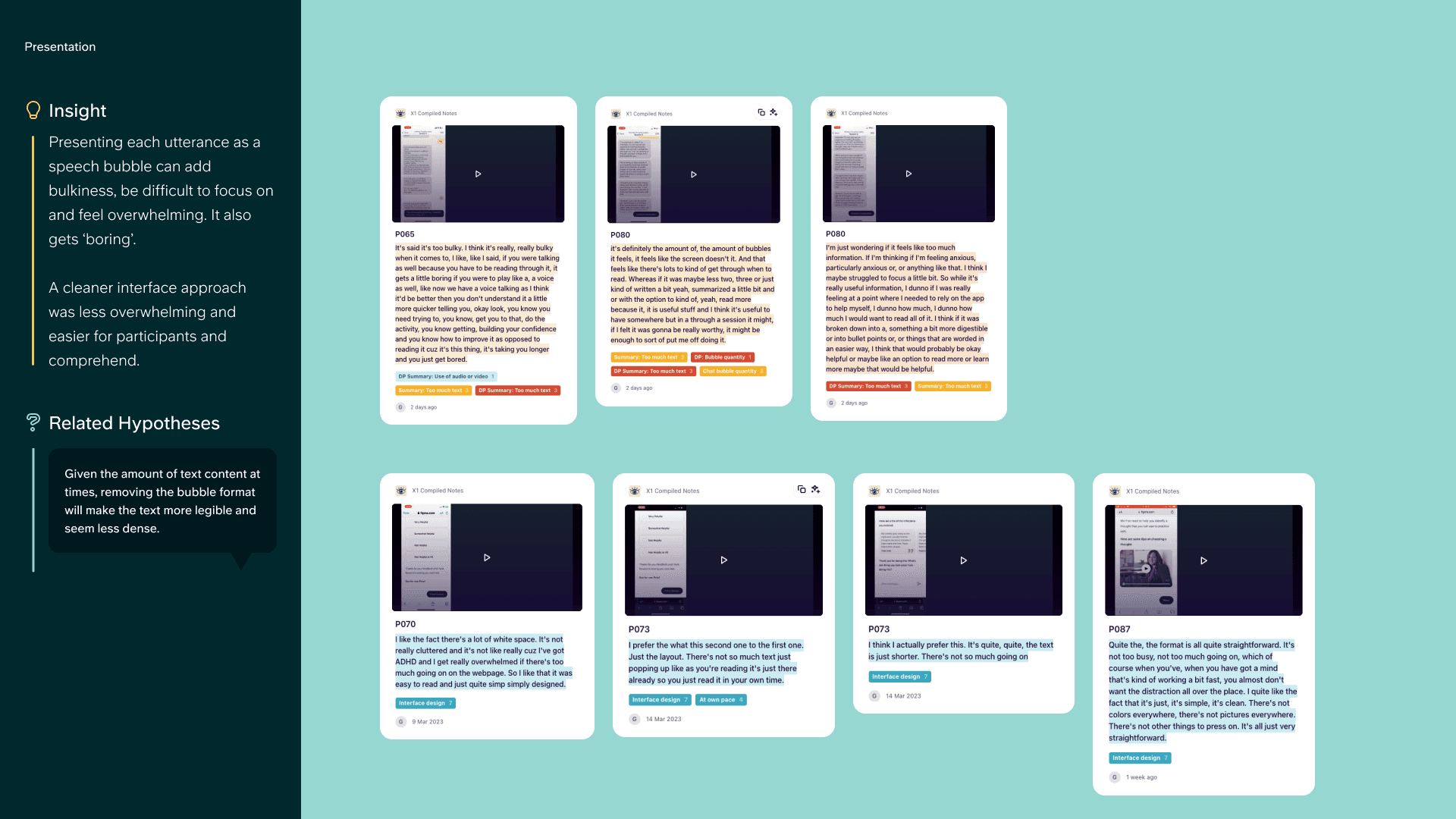
Long sequences of message bubbles felt bulky, repetitive and difficult to focus on.

Long sequences of message bubbles felt bulky, repetitive and difficult to focus on.

The same therapeutic content, presented as a conventional chat and as a more varied digital session.

The same therapeutic content, presented as a conventional chat and as a more varied digital session

Video and audio made clinical ideas easier to understand—and the sessions more interesting.

Video and audio made clinical ideas easier to understand—and the sessions more interesting.

Long sequences of message bubbles felt bulky, repetitive and difficult to focus on.

Long sequences of message bubbles felt bulky, repetitive and difficult to focus on.

The same therapeutic content, presented as a conventional chat and as a more varied digital session.

The same therapeutic content, presented as a conventional chat and as a more varied digital session

Video and audio made clinical ideas easier to understand—and the sessions more interesting.

Video and audio made clinical ideas easier to understand—and the sessions more interesting.

Long sequences of message bubbles felt bulky, repetitive and difficult to focus on.

Long sequences of message bubbles felt bulky, repetitive and difficult to focus on.

I’m a visual learner… the videos were helpful to explain the principles better.

Study participant

[The message bubbles] feel like too much information. If I'm feeling anxious, I think maybe I’d struggle to focus.

Study participant

What We Learned From the Comparison

The varied version was easier to follow and made room for different ways of learning. The research did not remove conversation from the product; it stopped chat from being the automatic answer to every therapeutic moment.

01

Less text-message styling made longer clinical content easier to read.

02

Video and audio made some ideas clearer and more engaging.

03

A session could still feel personal without presenting every line as chat.

04

Different moments needed different formats—not a single default.

02

From Findings to Session Patterns

The research led to three principles—clear, frictionless and personal—and a practical pattern library the team could reuse.

02

From Findings to Session Patterns

The research led to three principles—clear, frictionless and personal—and a practical pattern library the team could reuse.

People using digital therapy may already be tired, anxious or struggling to concentrate. The principles gave us a practical way to respond: present ideas clearly, make it obvious what to do next and ensure the experience still felt personal.

Clear, frictionless and personal—the principles used to review each digital therapy session

Turning Principles into Working Patterns

For each session, I reviewed the clinical content with the team, mapped the experience and looked for moments where another format could make the therapy easier to understand or take part in. Prototyping those moments revealed patterns we could reuse rather than inventing every session from scratch.

Mapping a therapy session to find where another format could improve understanding or engagement

Focused activities gave exercises a clear structure without forcing them through chat.

Focused activities gave exercises a clear structure without forcing them through chat

Personalised examples helped people answer questions that initially felt abstract.

Personalised examples helped people answer questions that initially felt abstract

Inline cards broke longer lists into information people could process and revisit.

Inline cards broke longer lists into information people could process and revisit

Focused activities gave exercises a clear structure without forcing them through chat.

Focused activities gave exercises a clear structure without forcing them through chat

Personalised examples helped people answer questions that initially felt abstract.

Personalised examples helped people answer questions that initially felt abstract

Inline cards broke longer lists into information people could process and revisit.

Inline cards broke longer lists into information people could process and revisit

Focused activities gave exercises a clear structure without forcing them through chat.

Focused activities gave exercises a clear structure without forcing them through chat

Personalised examples helped people answer questions that initially felt abstract.

Personalised examples helped people answer questions that initially felt abstract

Inline cards broke longer lists into information people could process and revisit.

Inline cards broke longer lists into information people could process and revisit

When Showing Worked Better Than Explaining

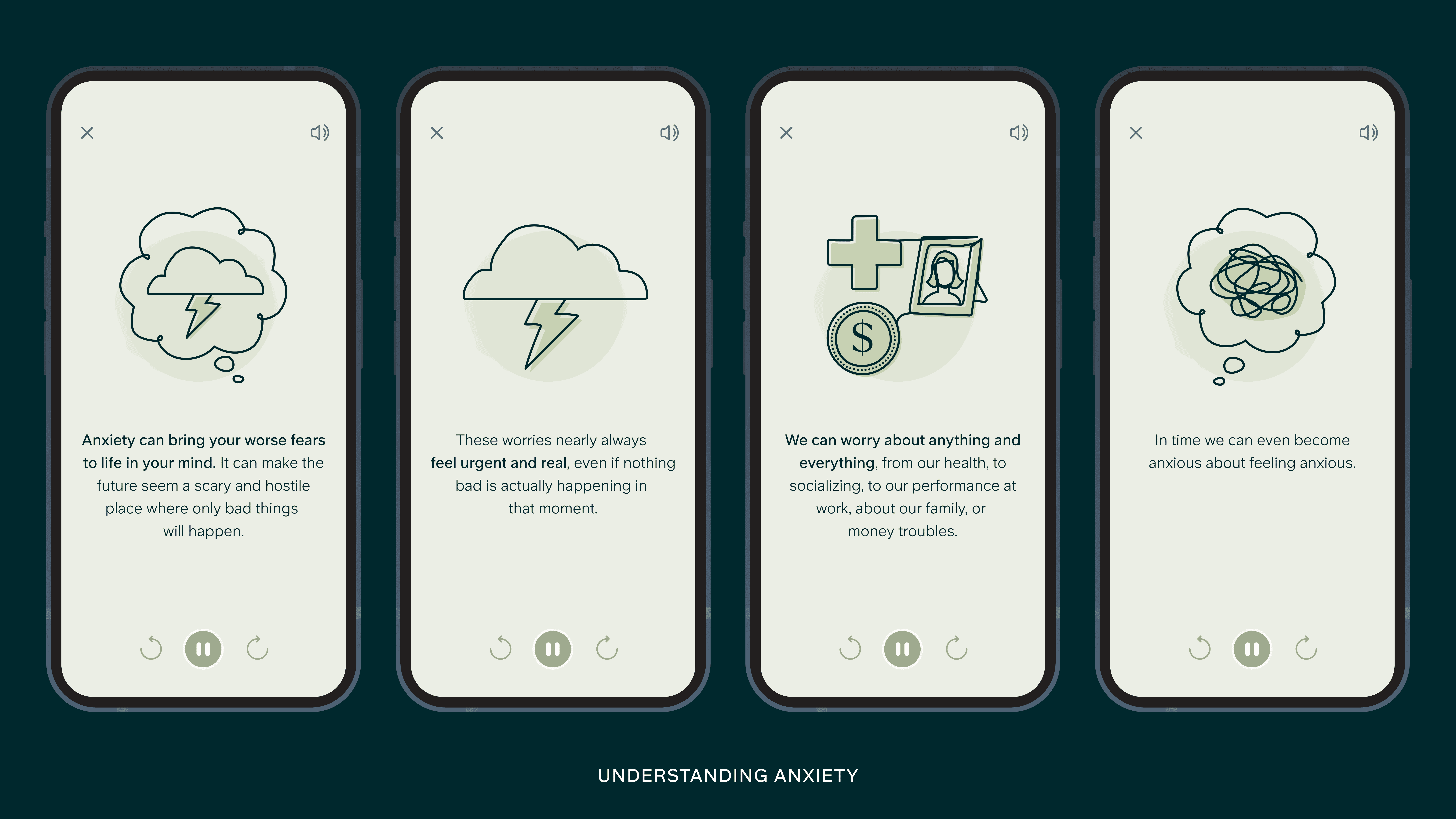
Some clinical concepts became long, tiring chatbot explanations. I worked with Clinical and an animator to turn key concepts and therapeutic metaphors into short videos, audio and animation that could explain an idea or guide an exercise more clearly. The narrator was an AI voice generated with ElevenLabs. I worked with Clinical to write the scripts and spent time tuning the narrator’s pronunciation, pacing and emphasis until it sounded calm and natural. Some colleagues were initially uneasy about using an AI voice, but people using the live product responded warmly: they praised the voice, found it calming and often singled the videos out as their favourite parts of the experience.
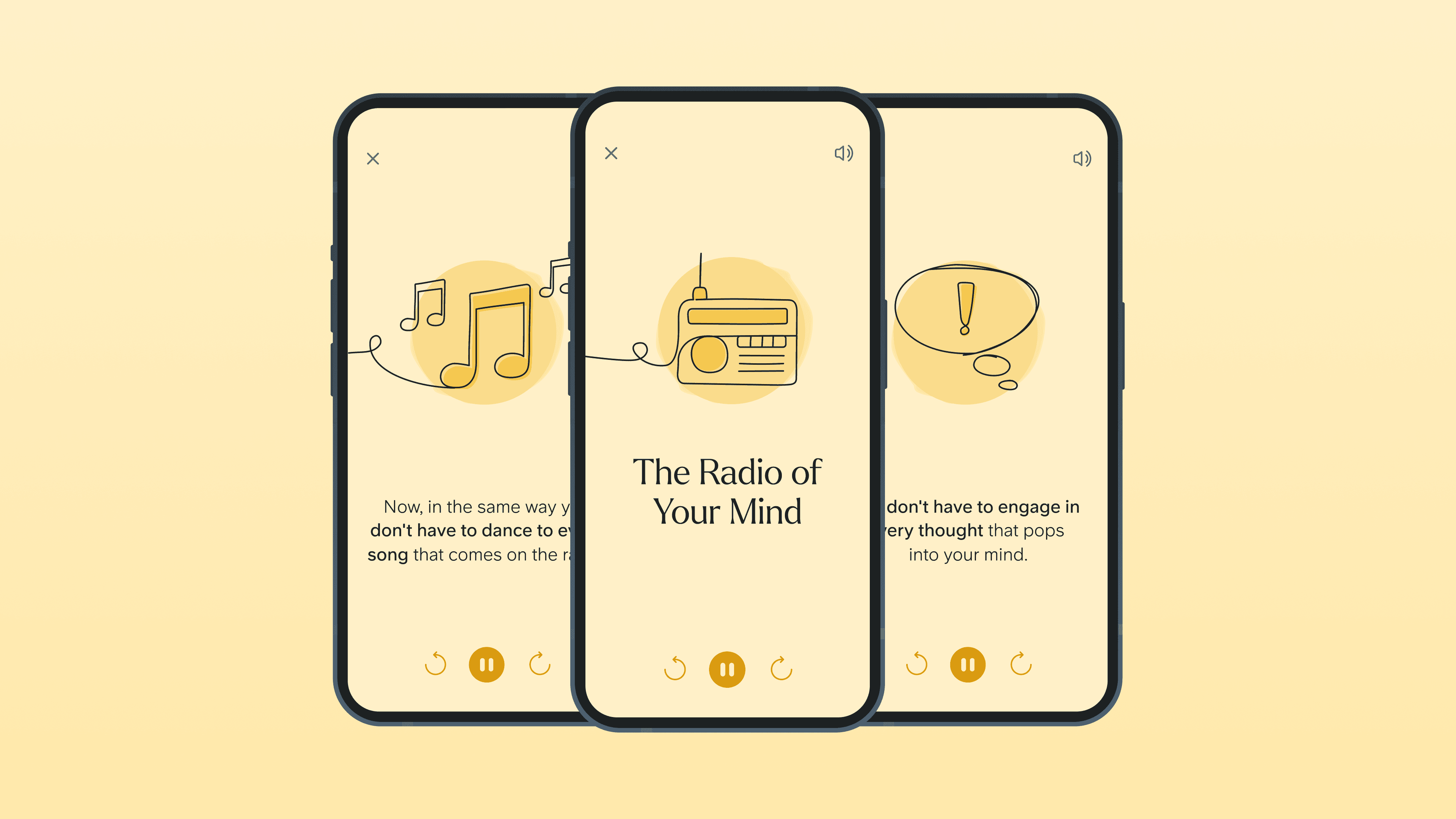
The Radio of Your Mind—using a visual metaphor to make cognitive defusion easier to grasp. Includes audio.

The Teacher — using a metaphor to make self-compassion easier to grasp.

The Teacher — using a metaphor to make self-compassion easier to grasp

Understanding Anxiety — helping people recognise anxiety in themselves, feel less alone, and see that things can get better.

Understanding Anxiety — helping people recognise anxiety in themselves, feel less alone, and see that things can get better

The Teacher — using a metaphor to make self-compassion easier to grasp.

The Teacher — using a metaphor to make self-compassion easier to grasp

Understanding Anxiety — helping people recognise anxiety in themselves, feel less alone, and see that things can get better.

Understanding Anxiety — helping people recognise anxiety in themselves, feel less alone, and see that things can get better

The Teacher — using a metaphor to make self-compassion easier to grasp.

The Teacher — using a metaphor to make self-compassion easier to grasp

Understanding Anxiety — helping people recognise anxiety in themselves, feel less alone, and see that things can get better.

Understanding Anxiety — helping people recognise anxiety in themselves, feel less alone, and see that things can get better

The videos were really powerful.

User of the live product

I liked the metaphors the best. They explained things so well, in such an interesting way.

User of the live product

I could just sit down and… relax, listening to what he was saying.

User of the live product

Turning Someone’s Own Words Into an Interactive Exercise

Sessions could still provide the personal context without remaining in the chat interface. In one cognitive-defusion exercise, the product reused words someone had shared earlier, then let them stretch, shrink and jumble those words on screen. The interaction turned an abstract therapeutic idea into something people could see and manipulate. It connected the conversation to a focused interactive experience. This pattern was better suited to experiential exercises, where people are asked to notice, feel or try something in real time: the interface could guide the moment and make the result visible, without asking someone to work through another long exchange of messages.

A challenging thought shared earlier became part of a personalised cognitive-defusion exercise

03

When Voice Helped

Voice was not on the roadmap. A working prototype showed why it could be the right format for someone reaching out in a difficult moment.

03

When Voice Helped

Voice was not on the roadmap. A working prototype showed why it could be the right format for someone reaching out in a difficult moment.

In-the-moment support was designed for moments when someone needed help now—perhaps during a flare-up or in the middle of the night—not for a scheduled therapy session. Research suggested people needed an easier way to explain what was happening, but voice was seen internally as technically complicated and lower priority than the product’s existing challenges. I felt that typing asked too much of someone at exactly the wrong moment. Rather than try to communicate the idea through static screens, I built a working prototype in Claude Code, using the Claude API for the interaction and ElevenLabs for speech. I experimented with different approaches to reduce latency until the conversation felt natural enough to use through AirPods while walking. Experiencing it changed the conversation. The prototype was used in customer demonstrations, where people responded enthusiastically and began asking when voice would be available. It turned voice from an abstract technical burden into an experience that Product, Engineering and customers could understand and evaluate.
In-the-moment support combined conversational support with short exercises for difficult moments

Where voice helped

In user testing, not everyone chose voice, but those who did valued the freedom to explain what was happening in their own words. It gave in-the-moment support richer context while leaving their eyes and hands free for the exercise.

Where voice helped

Not everyone chose voice, but those who did valued the freedom to explain what was happening in their own words. It gave Guided Support richer context while leaving their eyes and hands free for the exercise.

Where voice helped

In user testing, not everyone chose voice, but those who did valued the freedom to explain what was happening in their own words. It gave in-the-moment support richer context while leaving their eyes and hands free for the exercise.

What Voice Couldn’t Solve

Voice made the interaction easier, but it could not rescue an experience offering the wrong kind of help. Two participants arrived wanting practical answers, so a reflective exercise felt evasive. The issue was the fit between their intent and the exercise—not whether they spoke or typed.

It’s like a back-to-back conversation… it makes it more engaging.

Study participant, moderated prototype test

It’s like a back-to-back conversation… it makes it more engaging.

Study participant, moderated prototype test

If I’m using my voice, I feel like I have to respond immediately… if I’m typing, I can gather my thoughts.

Study participant, moderated prototype test

If I’m using my voice, I feel like I have to respond immediately… if I’m typing, I can gather my thoughts.

Study participant, moderated prototype test

It wasn’t robotic at all. It felt like a real person.

Study participant, moderated prototype test

It wasn’t robotic at all. It felt like a real person.

Study participant, moderated prototype test

The finding wasn’t that voice should replace typing. It was that people should be able to use the input that suited the moment. Voice later became an option more broadly across the programme, rather than remaining tied to in-the-moment support.

The finding wasn’t that voice should replace typing. It was that people should be able to use the input that suited the moment. Voice later became an option more broadly across the programme, rather than remaining tied to Guided Support.

The finding wasn’t that voice should replace typing. It was that people should be able to use the input that suited the moment. Voice later became an option more broadly across the programme, rather than remaining tied to in-the-moment support.

04

When Structure Worked Better

Some therapeutic work needed more than a conversation. People needed visible structure, while AI could still respond when a fixed flow was not enough.

04

When Structure Worked Better

Some therapeutic work needed more than a conversation. People needed visible structure, while AI could still respond when a fixed flow was not enough.

The Values exercise was one of several Foundations activities designed to run alongside the main therapy programme. Together, they helped people identify what mattered to them, recognise patterns and turn those insights into practical next steps. Those outputs could then make later support more personal. Rather than turn the exercise into another chatbot exchange, I explored it as an AI-guided activity: one decision at a time, personalised examples when questions felt abstract, earlier answers brought back at the right moment and a visible summary at the end. This was not about using less AI. AI still interpreted free-text answers, suggested values in each person’s own language and briefly shifted into conversation when someone needed help getting unstuck.

The AI-guided Values activity combined structured steps with personalised recommendations and conversational help.

Question

Which Format Best Suited This Exercise?

The Values exercise asked people to pause, compare options and reconsider earlier answers. I wanted to test whether it worked better as an AI-guided activity or a fully conversational experience.

Question

Which Format Best Suited This Exercise?

The Values exercise asked people to pause, compare options and reconsider earlier answers. I wanted to know whether that worked better as a guided worksheet or a fully conversational experience.

Question

Which Format Best Suited This Exercise?

The Values exercise asked people to pause, compare options and reconsider earlier answers. I wanted to know whether that worked better as a guided worksheet or a fully conversational experience.

Design Response

I built both versions and tested them side by side. The AI-guided activity made the steps and final result visible, while AI interpreted free text, reflected meaning back, suggested personalised values and opened a short conversation when someone needed help. A final screen showed how those values would shape later support.

Design Response

I built a guided worksheet and a conversational chatbot, then tested them side by side. The worksheet made the steps and final result visible, while AI interpreted free text, reflected meaning back, recommended personalised values and opened a short conversation when someone needed help. A final screen showed how those values would shape later support.

Design Response

I built a guided worksheet and a conversational chatbot, then tested them side by side. The worksheet made the steps and final result visible, while AI interpreted free text, reflected meaning back, recommended personalised values and opened a short conversation when someone needed help. A final screen showed how those values would shape later support.

Learning

The AI-Guided Activity Was the Stronger Fit

All five people who tested the AI-guided activity found it worthwhile and said it held their attention; all said they would revisit their answers. The conversational version was comfortable to use, but participants found it less natural and less useful for this exercise.

Learning

The Worksheet Was the Stronger Fit

All five people who tested the worksheet found it worthwhile and said it held their attention; all said they would revisit their answers. The conversational version was comfortable to use, but participants found it less natural and less useful for this exercise.

Learning

The Worksheet Was the Stronger Fit

All five people who tested the worksheet found it worthwhile and said it held their attention; all said they would revisit their answers. The conversational version was comfortable to use, but participants found it less natural and less useful for this exercise.

This is really cool — this is an app I’d actually like to use.

Study participant, AI-guided activity prototype

This is really cool — this is an app I’d actually like to use.

Study participant, AI-guided activity prototype

I feel like I just got something out of that besides just testing a product.

Study participant, AI-guided activity prototype

I feel like I just got something out of that besides just testing a product.

Study participant, AI-guided activity prototype

I would want it to feel more natural, more human-like.

Study participant, conversational prototype

I would want it to feel more natural, more human-like.

Study participant, conversational prototype

Voice Improved the Conversational Version—But the AI-Guided Activity Still Performed Better in Testing

To test whether typing had held the conversational version back, I added optional voice and tested it again.

Adding voice made the conversational version easier to answer, but the guided worksheet still made the exercise clearer and more useful.

Finding

Voice Reduced Input Friction

Dictation made longer answers easier for some participants.

Comparison

Structure Still Mattered

Speaking did not make the conversational version feel clearer or more useful. The AI-guided activity remained the stronger format.

Learning

Combine Structure With Responsive AI

The stronger approach used visible structure, with AI interpreting, personalising and helping someone get unstuck.

Reflection

This work did not begin with a formal brief to rethink the interaction model. I pursued it because the evidence showed that chat alone was limiting the experience. Given ieso’s history with typed therapy, I knew the clearest way to challenge that assumption was to show workable alternatives.

Working prototypes changed the conversation. Once teams could see how people responded to voice, structured exercises and richer media, moving beyond the chatbot stopped feeling speculative. Voice later became available across more of the programme, while structured activities and media supported moments that benefited from greater clarity or focus.

Chat remained valuable—but as one format among several, chosen because it suited the therapeutic moment.

Reflection

This work did not begin with a formal brief to rethink the interaction model. I pursued it because the evidence showed that chat alone was limiting the experience. Given ieso’s history with typed therapy, I knew the clearest way to challenge that assumption was to show workable alternatives.

Working prototypes changed the conversation. Once teams could see how people responded to voice, structured exercises and richer media, moving beyond the chatbot stopped feeling speculative. Voice later became available across more of the programme, while structured activities and media supported moments that benefited from greater clarity or focus.

Chat remained valuable—but as one format among several, chosen because it suited the therapeutic moment.

© 2026 - Jack Larner